
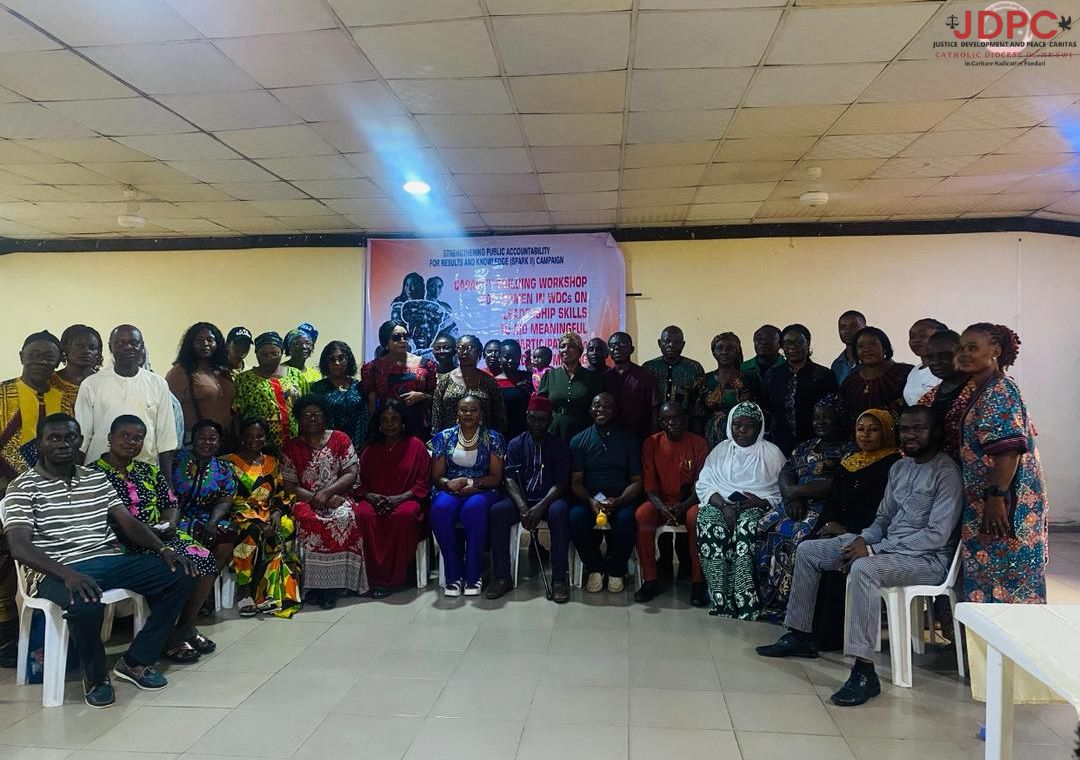
Women In WDC across Anambra State have been encouraged to take the lead in driving reforms and improving the effectiveness of Primary Healthcare Centres through their roles in Ward Development Committees. This call was made during a capacity-building workshop on health governance and accountability held under the SPARK II (Strengthening Public Accountability for Results and Knowledge) campaign.
The event, implemented by JDPC Nnewi in partnership with Community Empowerment Network (COMEN), Civil Rights Concern (CRC), and the Social and Integral Development Centre (SIDEC), with support from the International Budget Partnership, aimed to strengthen women’s participation in local health decision-making and governance.
Speaking at the event, the Executive Secretary of the Anambra State Primary Health Care Development Agency, Dr. Chisom Uchem, represented by Dr. Ngozi Okeke, urged women to take active and selfless roles in improving PHCs. She noted that women understand the health challenges within their communities better and are key to building responsive and efficient systems.
Dr. Okeke explained that the Basic Health Care Provision Fund depends on strong community involvement and accountability. She outlined key areas that guide PHC planning, including service delivery and infrastructure maintenance, financial documentation, human resource support such as stipends for volunteers, and maternal and child health programs that focus on mothers, newborns, and adolescents.
She also encouraged communities to support their local PHCs through contributions that can help with fencing, toilets, and basic equipment. According to her, such involvement goes a long way in sustaining healthcare centres that often struggle with limited facilities.
In her remarks, Ugochi Ehiahuruike, IBP SPARK Consultant , reminded participants that leadership is not about titles but about empowering others and driving positive change. She noted that the number of women chairing Ward Development Committees is still low and encouraged more women to step up, lead with confidence, and promote inclusivity for everyone, including persons with disabilities.
Rev. Fr. Ben Okolo, Director of JDPC Nnewi, described the initiative as a major step toward improving healthcare delivery at the grassroots. He urged women not to feel intimidated but to use their firsthand experiences to push for solutions and hold local systems accountable.
The State Chairman of COMEN, Ide Godwin Eze, acknowledged the government’s ongoing efforts but said more community-driven action is still needed. He encouraged women to speak up when things are not working as they should and to continue ensuring that quality health services reach the people.
JDPC Programme Manager, Onyekachi Ololo, explained that SPARK II is not against the government but rather a partnership that supports proper implementation of health policies. He assured participants that any unresolved issues would be taken to the relevant authorities for action.
By the end of the workshop, participants reaffirmed their commitment to promoting transparency, inclusivity, and sustainability within primary healthcare centres. The program highlighted that when women lead with knowledge, integrity, and passion for their communities, the entire healthcare system becomes stronger and more responsive to the people’s needs.